
GPA Introduction
Introduction
Many morphometric analyses require that the researcher perform a
Generalized Procrustes Analysis (GPA) in order to extract shape
variables (that is, variables that do not include information on scale,
translation, or rotation) from their landmark data. A GPA can be
performed in geomorph using the function
gpagen. This can be done with datasets composed of
anatomical (fixed) landmarks as well as those with sliding
semilandmarks.
plotAllSpecimens(plethodon$land)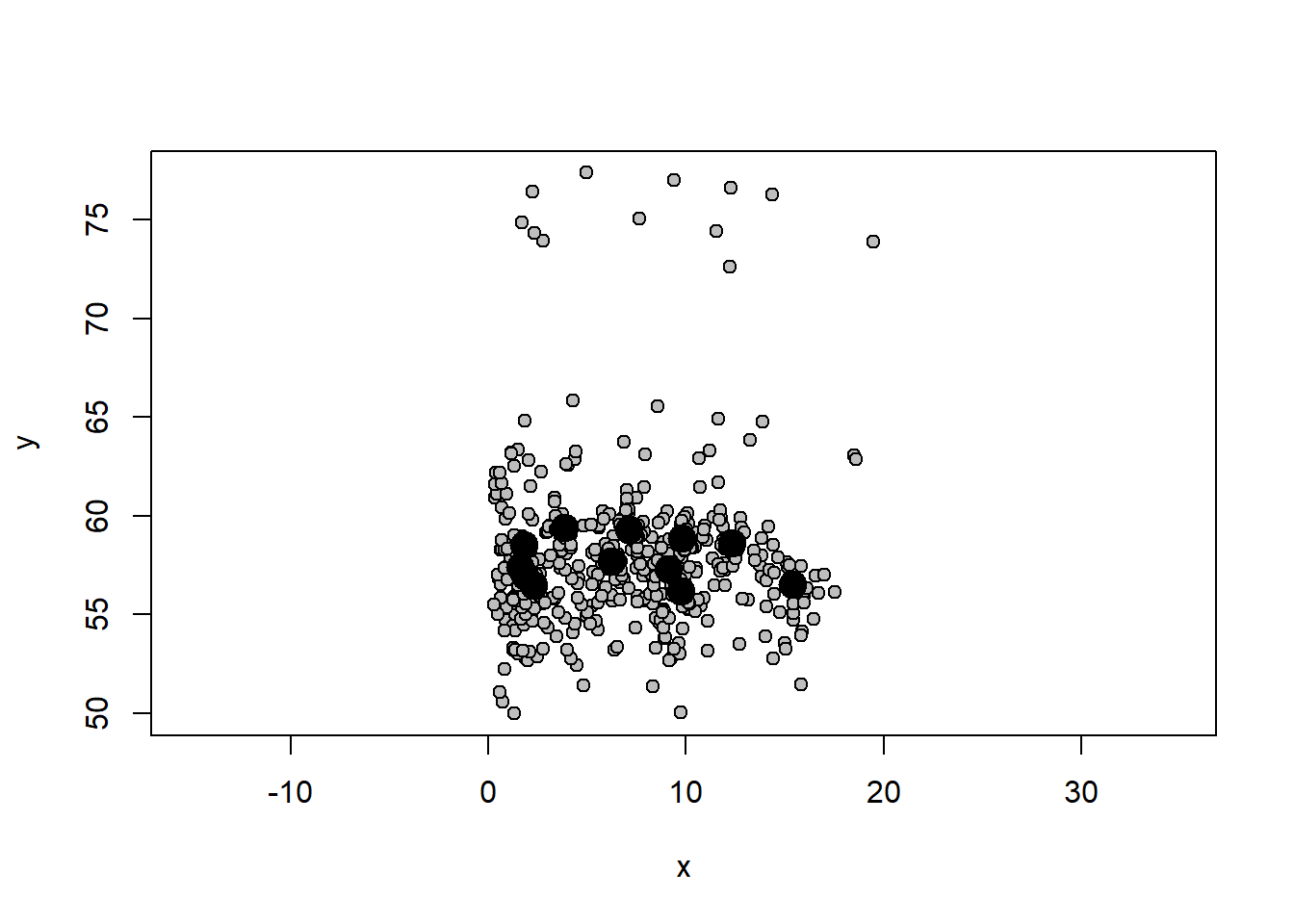
gpagen() (Expand for more details)
- \(A\): The input data to be aligned. Must be in Array format.
- \(curves\): An optional matrix defining which landmarks should be treated as curve semilandmarks. See below for more details.
- \(surfaces\): An optional input defining which landmarks should be treated as surface semilandmarks.
- \(print.progress\): Logical value indicating whether a progress bar should be printed to the screen.
This is a very large function with several other potential arguments which we describe in the Advanced Options tutorial. See below for a full breakdown of the, also large, output of this function.
Output
The output of this function is a large list, or gpagen
object with several subsets:
- \(coords\): An array of Procrustes shape variables. In other words, the aligned landmark coordinates.
- \(Csize\): A vector of centroid sizes for each specimen.
- \(consensus\): The mean (consensus) configuration, or shape of the input data.
- \(ProcD\): A Procrustes distance matrix for all specimens.
- \(p\): The number of landmarks.
- \(k\): The number of dimensions.
- \(nsliders\): The number of curve semilandmarks.
- \(nsurf\): The number of surface semilandmarks.
- \(call\): The user-input code.
The following gpagen outputs are associated with arguments that are discussed elsewhere, in the Advanced Options tutorial:
- \(iter\): The number of GPA iterations until convergence was found.
- \(points.VCV\): A variance-covariance matrix among Procrustes shape variables.
- \(points.var\): Variances of landmark points.
- \(data\): Data frame with a matrix of Procrustes shape variables and centroid size.
- \(Q\): Final convergence criterion value.
- \(slide.method\): Method used to slide semilandmarks.
Each of these subsets can be accessed separately using the ‘$’ operator, like so: